
Titan Watermaker: An Engineering Approach to Freshwater Production at Sea
Freshwater management at sea is about more than production capacity. System architecture, prefiltration, reverse osmosis, serviceability and proper vessel integration all play a role in long-term performance. Titan Watermaker approaches onboard freshwater production as an integrated marine engineering system.
Titan Watermaker: An Engineering Approach to Freshwater Production at Sea
Freshwater may appear to be one of the simplest resources onboard, yet it can influence almost every aspect of voyage planning.
For short stays around marinas, filling the freshwater tanks before departure may be sufficient. As voyages become longer, the number of people onboard increases or the vessel spends more time away from shore-based infrastructure, however, the question changes.
It is no longer simply about how much water can be stored.
It becomes a question of how freshwater demand can be managed sustainably onboard.
This is the principle behind the Titan Watermaker approach: not simply filtering seawater, but managing the complete process of converting it into freshwater through a controlled reverse-osmosis system designed for the marine environment.
From Seawater to Freshwater: Where Does the Process Begin?
When looking at a marine watermaker, the membrane housing or prefilters are often the most immediately recognisable components.
Yet freshwater production is not performed by a single component.
It is a complete process that begins with seawater entering the system and continues through several stages before freshwater is produced.
The incoming seawater is first prepared to protect the components downstream. It is then pressurised and directed toward the reverse-osmosis membrane, where water molecules are separated from the majority of dissolved salts.
Two separate flows are ultimately produced:
Fresh product water and a concentrated seawater stream, commonly referred to as brine.
For this reason, describing a watermaker simply as a “filter” does not fully represent the technology.
A marine watermaker is better understood as an integrated seawater desalination system combining hydraulic, mechanical, filtration and control technologies.
Why Is Prefiltration So Important?
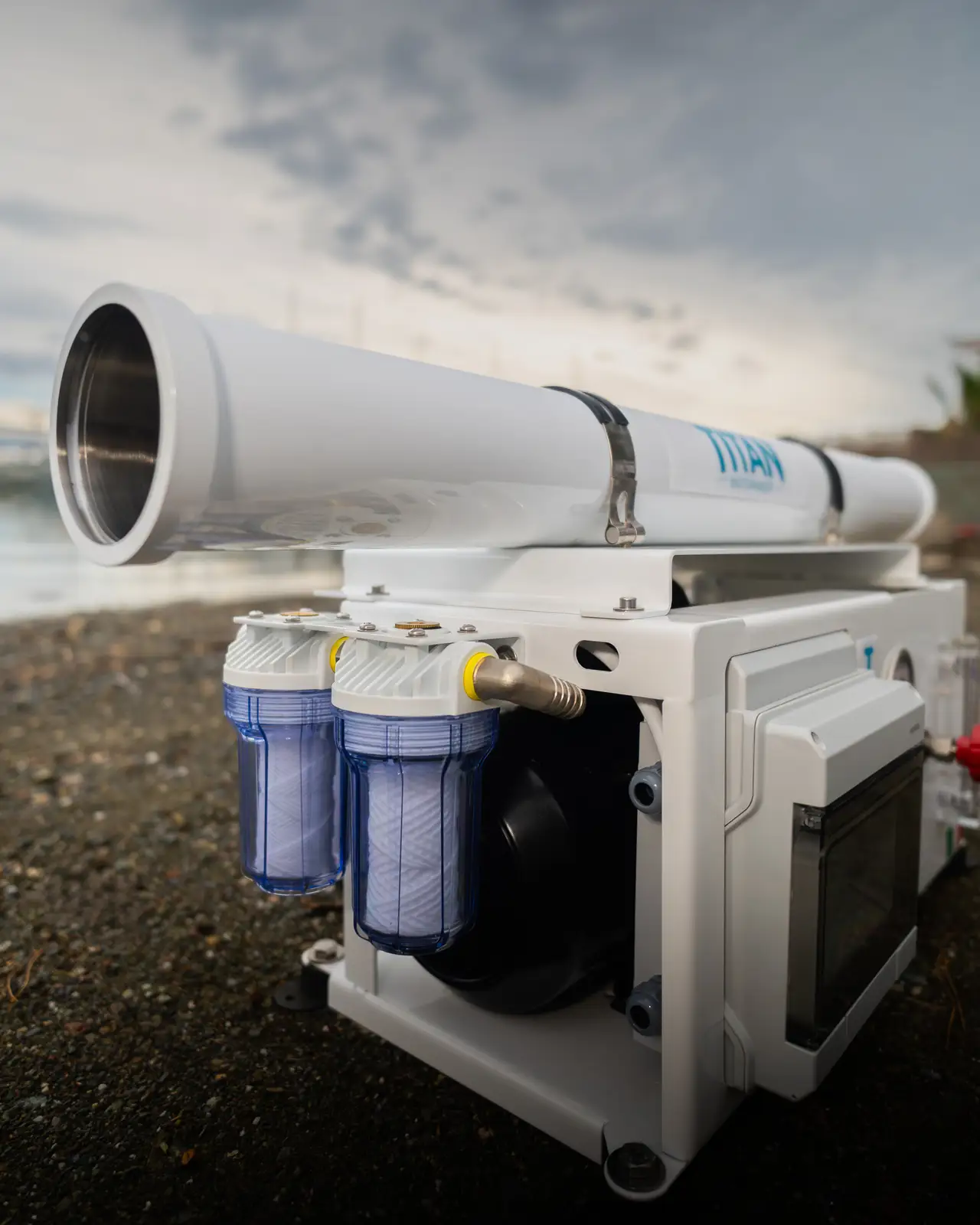
One of the most visible elements of the Titan Watermaker system is its prefiltration section.
The transparent filter housings are not merely a visual feature of the system architecture. Prefiltration plays a critical role in preparing seawater before it reaches the high-pressure and membrane stages.
Depending on location and operating conditions, seawater may contain varying levels of suspended solids, organic material and other particles.
Allowing this material to reach downstream components without adequate treatment can affect the operating conditions of the system.
Prefiltration therefore acts as an important first line of protection.
Making filters accessible and easy to inspect also contributes to maintainability.
In a well-designed marine watermaker, filtration is not only part of system performance.
It is also part of serviceability.
Reverse Osmosis: The Technology at the Core of the System
The elongated membrane housing positioned across the upper section of the Titan Watermaker contains the central separation stage of the freshwater production process.
Reverse osmosis operates by applying pressure to seawater and forcing it across a semi-permeable membrane.
The membrane allows water molecules to pass while separating a significant proportion of dissolved salts and other substances.
The resulting product water can then be monitored and directed into the vessel's freshwater system when appropriate.
An important distinction, however, is that watermaker performance is not determined by the membrane alone.
Seawater temperature, salinity, prefilter condition, operating pressure, pump performance and maintenance all influence the overall process.
Reverse osmosis should therefore be viewed not as an isolated component, but as the central technology within a properly engineered system.
What Compact Design Really Means Onboard
Technical space is one of the most valuable resources on a vessel.
Engines, generators, batteries, pumps, HVAC equipment and numerous auxiliary systems all need to coexist within a limited machinery space.
For marine equipment, the word “compact” therefore means more than simply making a product smaller.
The real objective is to achieve the required technical function while using onboard space intelligently.
The Titan Watermaker architecture brings the membrane section, prefiltration and primary system components together in a structured arrangement designed to support integration within technical spaces.
However, a successful installation is not defined only by whether the unit physically fits.
Service clearance, filter replacement space, hose routing, electrical connections and ventilation all need to be considered alongside physical dimensions.
Why Serviceability Is Part of Marine Product Design
Marine equipment is not always serviced in a spacious workshop.
A filter replacement, connection inspection or technical intervention may need to be carried out inside a restricted engine room or machinery compartment.
For that reason, good marine engineering considers not only how equipment operates, but how it will be maintained.
The external accessibility of the filtration section and the visual separation of key components can make routine inspection and technical intervention easier to understand and manage.
This becomes particularly important in professional marine operation.
Captains and technical crews need to identify different sections of the system quickly and carry out routine checks without unnecessary complexity.
A Watermaker Is More Than a Standalone Machine
Installing a watermaker onboard should not be viewed simply as placing another piece of equipment in the engine room.
The system operates together with the vessel's seawater intake, prefiltration stages, pumping equipment, reverse-osmosis membrane, product-water line, brine discharge, electrical infrastructure, freshwater tanks and control system.
The wider technical environment of the vessel therefore needs to be considered before system selection and installation.
This is also why judging a watermaker purely by its litres-per-hour figure can be misleading.
A more useful question is:
How effectively can this system be integrated into the actual freshwater requirements and technical infrastructure of this vessel?
Define the Requirement Before the Capacity
Every vessel has a different freshwater consumption profile.
Vessel length matters, but it does not provide the complete picture.
Two vessels of similar size can operate under completely different conditions. One may carry two people on short coastal passages, while another may accommodate a larger crew for extended periods away from shore.
Those two scenarios should not automatically use the same water-production strategy.
Watermaker planning should therefore begin with the operating profile rather than with a product catalogue.
Daily freshwater demand, number of people onboard, tank capacity, intended daily watermaker operating time, available electrical infrastructure and voyage profile should all be evaluated together.
Only then does the required production capacity become meaningful.
Automation: The Less Visible Side of Freshwater Production
In modern marine systems, visibility and control can be as important as mechanical performance.
Freshwater production involves multiple operating parameters, including system pressure, water quality and overall operating status.
Automation is therefore much more than a graphical interface.
It is the technical communication layer between the system and its operator.
Being able to understand the condition of the watermaker, follow the production process and respond appropriately when necessary is an important part of everyday operation.
The purpose of effective automation is not to make the technology more complicated.
It is to make a complex process easier to understand and manage.
What Does It Mean to Design for the Marine Environment?
Marine equipment operates under conditions that are fundamentally different from many shore-based industrial applications.
Humidity, salt-laden air, vibration, temperature variation, limited service access and continuous vessel movement all need to be considered from the beginning of the engineering process.
For this reason, evaluating a watermaker solely on freshwater production capacity provides only part of the picture.
System construction, accessibility of connections, component layout, maintenance requirements and the ability to integrate with the vessel's existing infrastructure are equally important considerations.
The Titan Watermaker approach treats onboard freshwater production as a complete marine system rather than as the function of one individual component.
From Stored Water to Produced Water
For many years, freshwater management onboard was primarily treated as a storage problem.
More required water simply meant larger tanks.
Watermaker technology introduces another possibility:
Producing part of the required freshwater where it is needed.
This does not eliminate the need for freshwater tanks.
Instead, storage and production become complementary parts of the same strategy.
The tank provides a reserve, while the watermaker helps replenish and maintain that reserve during operation.
The question therefore shifts from:
“How much water can we carry?”
to: “How effectively can we manage our freshwater resources onboard?”
The Titan Watermaker Approach
Technically, the purpose of a watermaker is straightforward: converting seawater into usable freshwater.
What distinguishes a well-engineered marine system, however, is not simply its ability to perform that process.
The difference becomes apparent in how the system integrates with the vessel, how clearly it can be monitored, how accessible it remains for maintenance and how effectively it performs within real-world marine operating conditions.
Titan Watermaker approaches freshwater production as part of the vessel's wider technical infrastructure rather than as an isolated equipment function.
Because freshwater management at sea is not simply about having more water available.
It is about being able to manage the water you need, where you need it, through the right system.